
Understanding SAE Driving Automation Levels
Why the Industry Speaks the Language of SAE J3016
Introduction
The future of mobility is frequently described using terms such as autonomous, self-driving, or driverless. While these terms are common in public discussions, the automotive industry relies on a more precise framework.
SAE International’s J3016 standard establishes a common language for describing driving automation systems. Rather than asking whether a vehicle is “autonomous,” the framework identifies who is responsible for performing the Dynamic Driving Task (DDT) under specific operating conditions.
This distinction has become the foundation for engineering discussions, regulatory development, public policy, insurance, and product development throughout the mobility industry.
Why This Standard Matters
Most public conversations simplify automation into two categories:
- Human-driven
- Self-driving
The reality is considerably more nuanced.
SAE J3016 defines six distinct levels, beginning with no driving automation and progressing toward full driving automation under all operating conditions.
Understanding these levels helps clarify what current technologies can—and cannot—do.
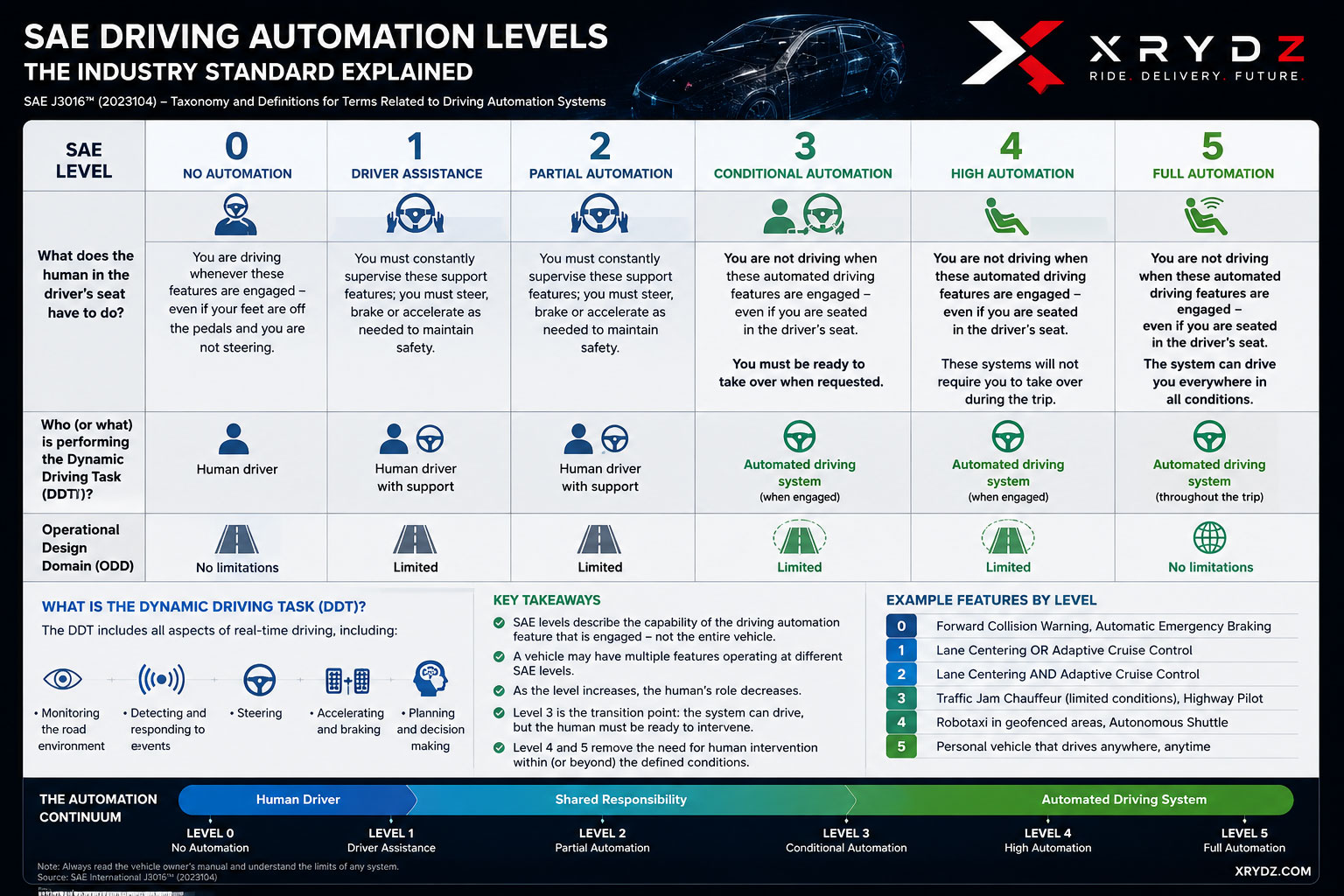
Reading the Diagram
(Introduce the infographic here.)
This reference summarizes the responsibilities associated with each SAE level, including:
- The role of the human occupant.
- The role of the driving automation system.
- The Dynamic Driving Task.
- Operational Design Domains (ODDs).
- Typical examples associated with each level.
Why XRydz Uses the SAE Framework
XRydz adopts the SAE J3016 framework because it provides a common engineering language for discussing driving automation.
Our focus extends beyond the vehicle itself. As transportation systems become increasingly automated, intelligent mobility also depends upon software coordinating communications, fleet operations, infrastructure, artificial intelligence, and connected transportation ecosystems.
Understanding vehicle automation is therefore only one component of understanding the future of intelligent mobility.
Looking Ahead
This page serves as a foundational reference introducing the industry’s standard terminology.
Future XRydz Perspectives, Research, and Technology articles will build upon these concepts while exploring intelligent mobility software, connected infrastructure, fleet orchestration, communications, and the broader systems supporting increasingly automated transportation.